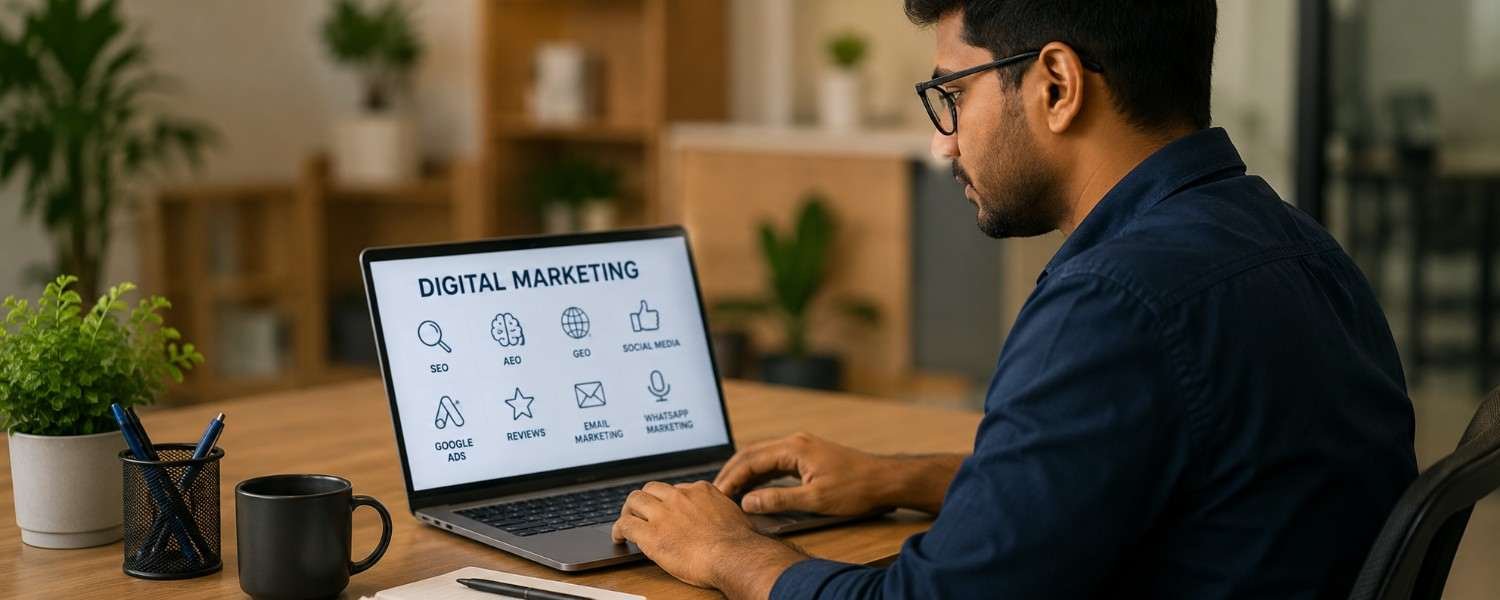
A customer can find your business online through nine channels: Google Search, Google Maps, AI assistants, AI Overviews, voice search, paid ads, social media, online reviews, and email or WhatsApp. Most Indian small businesses actively use only two. The other seven stay shut, and every closed channel is a customer walking into your competitor’s shop instead.
Each of these channels is run by a digital marketing service. We are MagnaWiz, a Noida-based digital marketing company that runs all nine. This guide covers each one: what it is, whether you need it, and which three to open first.
Key Takeaways
- There are nine channels a customer can use to find a business online; most Indian small businesses actively use only two.
- The fastest wins for a small business are Local SEO, Google reviews, and SEO, in that order.
- AI search (AEO and GEO) is now a separate channel from Google ranking; 60% of sources cited by AI tools are not in Google’s top 10 results.
- Only 5% of businesses respond to reviews, while 89% of consumers expect a response, making review replies the highest-return low-cost move.
- No business needs all nine channels; most need three running well before adding a fourth.
What are Digital Marketing Services?
Digital marketing services are the paid and unpaid online activities that put a business in front of customers across Google, AI assistants, voice search, social media, reviews, ads, and direct messages. Each service manages one of those paths. A customer finds you when at least one path is built and maintained.
Three words get mixed up, so here is the plain version:
- A channel is where the activity happens, like Google, Instagram, or WhatsApp.
- A service is the work an agency delivers, like SEO, social media management, or Answer Engine Optimization.
- A strategy is the plan that decides which services to run and in what order. Strong digital marketing strategies integrate multiple services so they support one another rather than operating in isolation.
Knowing the difference matters because most owners buy a service without a strategy, then wonder why one channel alone didn’t bring customers.
Most Indian Businesses Use Only 2 of These Channels
Most Indian small businesses use two channels: a website and a social media page. The remaining seven need setup, ongoing work, or technical skill that an owner running a business rarely has time for. So they stay shut.
The cost is quiet. You never see the customer who searched, found your competitor instead, and booked them. The business that opens four or five channels wins that customer, not because the product is better, but because it showed up where the customer was looking.
The 9 Ways Customers Find a Business Online
The nine services below are grouped by how a customer actually reaches you, starting with search, then AI search where the most change is happening, then the channels that catch and bring back customers.
Search Engine Optimization (SEO)
SEO is the technical and content work that makes your business rank when customers search the problems you solve. A homeowner in Sector 62 Noida types “AC repair near me,” and the top three results take most of the calls.
SEO covers your service pages, blog content, site speed, mobile experience, internal links, and backlinks. It compounds, which sets it apart from ads. A page that ranks today can keep producing enquiries two years later with no further spend. It also feeds the two AI channels below, because the content AI engines cite is the same content SEO produces. At MagnaWiz, we treat SEO as the foundation AI-search visibility is built on, because digital marketing and SEO only deliver when the technical base is right.
Answer Engine Optimization (AEO)
AEO is the work that gets your business named and cited when someone asks an AI assistant a question. A customer types “best chartered accountant in Noida” into ChatGPT or Perplexity, and the assistant returns three firms with citations. If your business is not one of them, the customer never learns you exist.
This channel is new, and most competitors have not built it. Research from Profound in 2026 found that 60% of the sources AI tools cite are not in Google’s top 10 organic results, so ranking on Google does not automatically get you cited by AI. Getting cited depends on clear answers, structured data, and consistent mentions across the web. We build this at MagnaWiz through our Answer Engine Optimization work, structuring pages so AI engines can lift a clean answer and attribute it to you.
Generative Engine Optimization (GEO)
GEO gets your business included in the AI summary that now sits at the top of many Google results. A customer searches a question, Google’s AI writes the answer and cites three to five sources, and the reader takes the answer without clicking any link below.
The traffic effect is measurable. Searches that trigger an AI Overview carry an 83% zero-click rate, according to Similarweb data, and Ahrefs found the top organic result loses about 34.5% of its clicks once an AI Overview appears. Being inside the summary now matters more than ranking under it. We handle this at MagnaWiz through Generative Engine Optimization, shaping content so Google’s AI and Gemini pull your business into the answer.
Here is how the three search channels differ, since owners mix them up most often:
| SEO | AEO | GEO | |
|---|---|---|---|
| What it optimises | Your ranking in Google’s blue-link results | Your citation inside AI assistants | Your mention inside AI search summaries |
| Where you appear | Google results page | ChatGPT, Perplexity, Claude | Google AI Overviews, Gemini |
| What earns the spot | Keywords, content quality, backlinks | Clear answers, structured data, web mentions | Strong SEO base plus citable, specific content |
| Who sees it | People who scroll results | People who ask an AI a question | People who read the AI summary first |
Local SEO
Local SEO places your business in the Google Maps pack, the three listings shown at the top of a local search. This is why a competitor with a complete, active profile shows up there while you stay buried. A customer searches “interior designer near me” or “dentist in Noida Extension,” sees three businesses on a map, and picks from those three.
Local SEO depends on a complete Google Business Profile, consistent name, address, and phone details everywhere online, and citations on Indian directories like Justdial, Sulekha, IndiaMART, and Practo. BrightLocal’s 2026 research found that 46% of consumers say they always or often add “near me” to local searches, which makes the map pack the most competitive space for any business with a service area. We manage this at MagnaWiz through Local SEO Optimization, and as a Noida-based team we build these profiles for businesses across Delhi NCR.
Voice Search Optimization
Voice Search Optimization structures your content so voice assistants read your business as the answer to a spoken question. A customer driving home says “Hey Google, find a tile shop in Sector 18 Noida,” and the assistant names one business, sometimes two, then stops.
Voice answers reward businesses with a complete Google Business Profile, a fast mobile site, and content written in a question-and-answer format that matches how people speak. Around 8% of search queries are phrased as full questions, and voice is where most of those land. This channel matters most for local service businesses where the search is hands-free and the customer is ready to act. We cover this at MagnaWiz under Voice Search Optimization.
Performance Marketing
Performance Marketing covers every paid channel where you pay for a measurable result: Google Search Ads, Display, YouTube Ads, and Meta Ads across Facebook and Instagram. A customer sees a sponsored result or a promoted Reel, clicks, and lands on your page. You paid for that click and the lead is yours the same day.
The strength is speed. A campaign goes live and traffic arrives within hours. The limit is that traffic stops the moment the budget stops, which is why no business should run on ads alone. Ads work best paired with SEO and AEO, buying leads now while the organic channels compound over months. We run this at MagnaWiz through Performance Marketing, pairing paid campaigns with the slower-build channels so the spend is not the only thing holding up the pipeline.
Social Media Optimization (SMO)
SMO is consistent presence on the platforms your customers already scroll. A customer sees your work appear for the fifth time this month and remembers you when the need arises. Instagram and Facebook carry most B2C discovery in India; LinkedIn carries B2B.
Short-form video drives the highest reported return of any content format, ahead of long-form video and live streaming, according to HubSpot’s 2026 State of Marketing report. Reels and YouTube Shorts now do the discovery work that static posts used to do. This channel needs steady output, which is why it suits businesses that can sustain weekly content rather than post once and stop. We manage this at MagnaWiz through Social Media Optimization.
Online Reputation Management (ORM)
ORM is the work of earning, monitoring, and responding to reviews so your business wins the final comparison. A customer narrows the choice to two businesses and opens the reviews. The one with 47 recent reviews at 4.7 stars wins. The one with 9 old reviews at 4.2 stars loses.
The numbers from BrightLocal’s 2026 Local Consumer Review Survey are direct:
- 97% of consumers read reviews before choosing a local business.
- 41% always read reviews when browsing, up from 29% the year before.
- 73% trust only reviews written within the last month.
- 92% want at least a 4-star rating before they will consider a business.
The gap most owners miss: only 5% of businesses respond to their reviews, while 89% of consumers expect a response. Responding to every review is the lowest-effort, highest-return move on this list. Across the businesses we have worked with at MagnaWiz, the ones that reply within 48 hours pull ahead of their competitors faster than from any other single change.
Conversational Marketing (Email and WhatsApp)
Conversational marketing uses email and WhatsApp Business to reach customers directly, with no platform deciding who sees the message. A past customer gets a WhatsApp update about a new service. A subscriber gets a monthly email useful enough to forward. Both come back to buy again.
WhatsApp Business is the stronger channel for most Indian small businesses, where messaging fits buyer behaviour better than cold email. A setup includes a product catalogue, broadcast lists, quick replies, and click-to-chat buttons on your website and ads. One rule now governs this channel: the DPDP Act 2023, with full compliance due by May 13, 2027, requires clear opt-in consent before you send marketing messages, so lists must be built on permission rather than bought. We set these up at MagnaWiz with consent baked in from the start.
Which of These 9 Should a Small Business in India Start With?
For a digital marketing plan for a small business, start with the three channels where customers are already looking for you, then add the next set once those run cleanly.
- Local SEO and Google Business Profile. Week one, usually free.
- Reviews and responses. Week one, free, the biggest impact for the cost.
- SEO on your service pages. Month one onward, compounds over time.
- Performance Marketing. When cash flow needs leads faster than SEO delivers.
- AEO and GEO. Month two onward, once your SEO content is structured cleanly.
- Social Media Optimization. When you can sustain weekly content.
- Voice Search Optimization. Mostly automatic once steps one to three are done well.
- Email and WhatsApp. Month two onward, once you have a list worth nurturing.
The order works because the first three channels catch customers who are already searching for you, while the later ones create demand that does not exist yet. Catch the demand that already exists before you try to create demand that doesn’t.
Open More Channels. Bring In More Customers.
At MagnaWiz, our founders bring more than 30 years of combined experience in digital marketing solutions for Indian businesses, across hundreds of clients, with a 5.0 average across 30 Google reviews, a Google Partner badge, and a Clutch listing. Our Growth Wizards open the channels that fit your business stage, not the ones that fit a pitch deck.
Book a call with our team about digital marketing services for your small business. We will audit which of the nine channels are open for you now, which are leaking customers, and which three to open first.
Talk to a Growth Wizard →
Phone: +91 (927)-829-9800
Email: info@magnawiz.com
FAQs
Why does my competitor show up on Google Maps and not me?
Your competitor most likely has a complete, verified Google Business Profile with consistent contact details, recent reviews, and the right business category. Google ranks the map pack on profile completeness, proximity, and review activity. A business that has not claimed or filled out its profile rarely appears, regardless of how good the service is.
How long does digital marketing take to show results?
Local SEO and review work show traction in two to four weeks. SEO takes three to six months for ranking movement. Performance Marketing brings traffic within hours but stops when the budget stops. AEO and GEO citations usually begin appearing in six to eight weeks once the content and technical basics are in place.
Is SEO still worth it now that AI search is growing?
Yes. AI engines pull their citations from the same indexed content SEO produces, so a well-structured site is what both Google AI Overviews and Perplexity pull from. SEO alone is no longer enough, but it remains the floor. Without it, neither AI search nor Google has anything to rank or cite.
What is the difference between SEO, AEO, and GEO?
SEO ranks your business in Google’s standard blue-link results. AEO gets your business cited as a source inside AI assistants like ChatGPT, Perplexity, and Claude. GEO gets your business included inside AI summaries like Google AI Overviews and Gemini. The content overlaps, but each one is optimised differently.
What is the typical budget for digital marketing in India?
It depends on how many channels you run and how competitive your market is. A single-channel start sits at the lower end; a full-service programme of SEO, social, ads, and content runs higher. Most Indian SMEs working across several channels budget in the mid-five-figures to low six-figures a month, separate from ad spend. The right figure comes from your scope, which is why we quote against your goals rather than a price list.
How many digital marketing services does my business actually need?
Most Indian small businesses need three channels running well before a fourth running poorly. The right three depend on whether you serve a local area, a national audience, or both. A neighbourhood clinic needs different channels than a national online brand. The shortlist comes from a short audit, not a fixed checklist.